
4 Stages of Gum Disease: Signs, Symptoms & Treatment
The 4 Stages of Gum Disease Explained: Premier Dentistry, Gresham OR

Think your gums are fine because it doesn’t hurt? Think again. Gum disease silently destroys bone and teeth—often without warning.
Catch it early, and you can save your smile, your money, and your confidence.
Picture this: You look in the mirror one day and notice your teeth look longer… your smile feels different… and suddenly a tooth is loose. That “sudden” moment? It actually started years ago — while you felt nothing at all. Almost HALF of adults over 30 already have gum disease destroying the bone around their teeth right now (CDC) — and 99% of them have no pain until it’s expensive or too late.
But here’s what most dentists won’t tell you upfront:
If we catch it in stage 1 or 2, we can almost always stop it completely — and you keep every single tooth.
The 4 stages (and how fast they sneak up):
- Gingivitis → Bleeding gums today → Fixed in 2 weeks
- Early Periodontitis → Silent bone loss starts → Still 100% savable
- Moderate → Teeth shifting, gaps appearing → Damage speeding up
- Advanced → Teeth falling out, thousands in implants → Often preventable
Every single day you wait, you lose bone that will never comes back on its own. But every patient who walks through our door today saying “I should have come sooner” leaves saying “I’m so glad I finally did.” Don’t let your smile become another regret story.
Book your quick, painless gum check right now — most people discover they’re only in stage 1 or 2 and breathe a huge sigh of relief.
Book an appointment or call us. Your future smile is counting on you today.
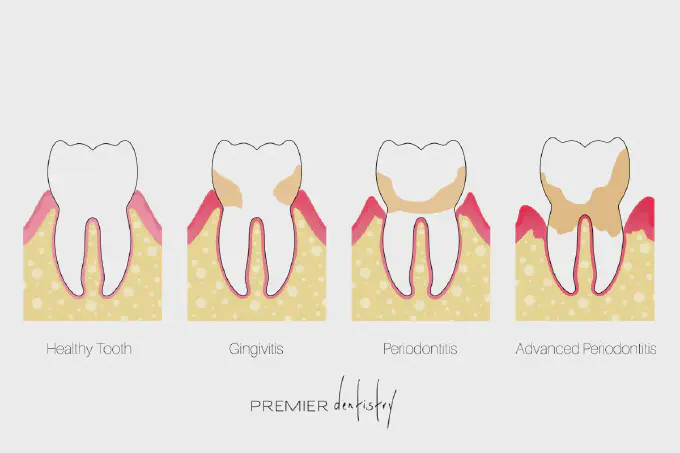
The 4 Stages of Gum Disease
Stage 1: Gingivitis – Completely Reversible
Gingivitis is the first stage of gum disease. It happens when plaque (a sticky film of bacteria) builds up on teeth and makes the gums sore.
Common signs:
- Red or swollen gums
- Bleeding when you brush or floss
- Bad breath
Good news: There is no damage to the bone or tissues yet.
Pocket depths are still normal (1–3 mm).
With a professional cleaning and better daily brushing and flossing, gingivitis goes away completely in just 1–2 weeks.
Most patients who bleed during their cleaning are at this stage — and they leave with perfectly healthy gums.
Stage 2: Early Periodontitis – Damage Has Started (But Still Very Treatable)
Now the infection has moved below the gum line. Small pockets (4–5 mm) form between the teeth and gums.
Signs you may notice:
- Gums starting to pull away from teeth
- Bad breath that won’t go away
- Slight sensitivity
The bone has lost 10–20% of its support (we can see this on X-rays).
Treatment: A deeper cleaning called scaling and root planing (done comfortably with numbing). We often place tiny antibiotic beads right where they’re needed.
When patients follow up every 3 months, the disease stops in over 95% of cases. We can still save every tooth at this stage.
Stage 3: Moderate Periodontitis – Damage You Can See and Feel
Pockets are now deeper (6–7 mm). Gums pull back, teeth may feel a little loose, and spaces can appear between teeth. Bone loss is 30–50%.
Treatment: We often use laser therapy or gentle surgery to clean deeply and help the gums reattach. With regular care, we can stop the disease and sometimes even grow new bone.
Stage 4: Advanced Periodontitis – Serious Risk of Losing Teeth
Pockets are very deep (over 7 mm). There is major bone loss (over 50%), and teeth can shift, shift or become very loose.
Signs:
- Constant bad taste
- Frequent sore spots or abscesses
- Pain when chewing
Treatment: More advanced surgery, bone grafts, splinting loose teeth, and sometimes removing teeth that cannot be saved and replacing them with implants.
At this stage our goal is to save as many natural teeth as possible and restore a healthy, comfortable smile.
The earlier gum disease is found and treated, the easier it is to fix — and the more teeth we can save for life.
Quick Comparison Table
| Stage | Pocket Depth | Bone Loss | Reversibility | Typical Treatment |
|---|---|---|---|---|
| 1. Gingivitis | 1–3 mm | None | 100% reversible | Pro cleaning + better hygiene |
| 2. Early Periodontitis | 4–5 mm | 10–20% | Stops with treatment | Deep cleaning (scaling/root planing) |
| 3. Moderate | 6–7 mm | 30–50% | Halts with surgery | Laser therapy or flap surgery |
| 4. Advanced | ≥8 mm | >50% | Partial salvage only | Surgery, grafting, implants |
Prevention That Actually Works in Gresham, OR
- Brush 2× daily with electric toothbrush
- Floss or Waterpik nightly
- Use therapeutic mouth rinse (we recommend CloSYS or PerioGuard)
- Professional cleanings every 3–6 months (depending on stage)
- Quit smoking/vaping – it doubles your risk overnight
Ready to find out your exact stage and stop gum disease before it causes bigger problems?
Call us today or book online for a gentle, no-pressure periodontal check. Most insurance accepted, payment plans available.
Check our patient resources page. Ready to Smile Brighter? Book Your Consultation Today
Schedule Your Free Consultation or call (503) 667-1184. Let’s get you on the path to straighter teeth—your Gresham smile awaits!